General Ledger, Subledger, Reconciliation Account: How Do They Fit Together?
Anyone working in SAP FI encounters these three terms constantly — but how they interact is often unclear. This article explains the underlying logic, why reconciliation accounts cannot be posted to directly, and what fundamentally changed with S/4HANA and ACDOCA.

Anyone working in SAP FI will encounter three terms early on that come up again and again: general ledger, subledger, reconciliation account. They are connected — but not in a way that is immediately obvious. This article explains what these concepts mean, how they work together, and what fundamentally changed with S/4HANA and the ACDOCA table.
The General Ledger: the central record of accounting
The general ledger is the core of financial accounting. This is where all postings relevant to the annual financial statements come together: revenues, expenses, assets, liabilities. In SAP, this is referred to as the General Ledger (GL). Every posting created in the system ultimately flows into the general ledger — either directly or indirectly through a subledger.
The general ledger works with G/L accounts. These are organized within a chart of accounts and reflect the structure of your balance sheet and profit and loss statement. When you post an invoice, record a payment, or make a transfer in SAP, these transactions are recorded on G/L accounts in the general ledger.
The Subledger: more detail where it is needed
The subledger exists because the general ledger alone cannot provide sufficient detail. Imagine you have 2,000 vendors. In the general ledger you see: "Accounts payable — €450,000." That is correct for the financial statements. But which vendor receives what amount and when? The general ledger does not hold that information.
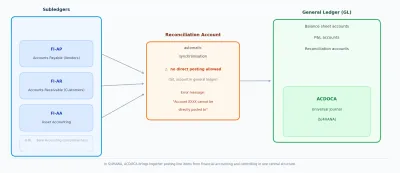
That is precisely what subledgers are for. The accounts payable subledger (FI-AP) tracks every invoice, every payment, and every open item per vendor. The same applies to the accounts receivable subledger (FI-AR) for customers, and to asset accounting (FI-AA) for fixed assets.
The classic subledgers in SAP FI are in particular:
- FI-AP — Accounts Payable (vendors)
- FI-AR — Accounts Receivable (customers)
- FI-AA — Asset Accounting
Further specialized components such as bank accounting (FI-BL) complement this structure, but are not classic subledgers in the same sense.
The Reconciliation Account: the bridge between subledger and general ledger
To prevent the general ledger and subledger from diverging, there is the reconciliation account. It is a special G/L account in the general ledger that is automatically kept in sync with the subledger. Every posting in the subledger simultaneously generates a posting to the corresponding reconciliation account in the general ledger.
This means you do not need to transfer or reconcile data manually — SAP handles that in the background. The total of all open items for your vendors in the accounts payable subledger always matches the balance of the "accounts payable" reconciliation account in the general ledger.
Why does SAP prevent direct postings to reconciliation accounts?
This is one of the most common questions in training — and one of the most frequent causes of error messages. Reconciliation accounts are blocked for direct postings in SAP. The reason: if you were to post directly to a reconciliation account, the automatic synchronization with the subledger would be broken. The general ledger and subledger would no longer be in agreement. SAP enforces this technically through a setting in the G/L account master data.
Reading error messages correctly
An honest observation shared by many training participants: SAP error messages are often written as though they are addressed to consultants or key users — not to end users who are simply trying to post an incoming invoice. This is a real issue, not a misunderstanding.
When you receive an error message while trying to post, it is worth checking three things:
| What SAP says | What it means | What to do |
|---|---|---|
| "Account XXXXXXXX cannot be directly posted to" | You are attempting to post directly to a reconciliation account — this is blocked. | Use the correct transaction for the posting (e.g. post a vendor invoice via FB60 rather than FB50). |
| "Vendor XXXXXXXXX is not defined for company code XXXX" | The vendor has not been set up in the selected company code. | Check the master data — or inform your key user if the vendor record is missing. |
| "Period 003/2026 is not open for account type K and ledger XXXXXXXX" | The posting date falls in a period that is no longer open for postings. | Check the posting date. Opening periods is a key user or consultant task. |
If you cannot interpret an error message: note the message number (e.g. F5 702) and contact your key user. That number is the fastest route to a targeted answer.
S/4HANA and ACDOCA: are subledgers still "real" subledgers?
With S/4HANA, SAP fundamentally changed the database architecture in financial accounting. In SAP ECC, there were genuinely separate tables for the general ledger and subledgers: BSEG for document-level data, BSAK/BSIK for vendors, BSAD/BSID for customers, ANLA/ANLZ for assets. Each of these tables had its own structure.
In S/4HANA there is the table ACDOCA — the Universal Journal. It brings together the relevant posting line items from financial accounting and controlling into a single central structure: general ledger, accounts payable, accounts receivable, asset accounting.
This raises a legitimate question: do subledgers still exist in S/4HANA?
The short answer: Yes — but technically different from before. The functional logic of general ledger and subledger remains intact: reconciliation accounts still exist, vendor and customer accounts still exist, asset values still exist. What has changed is how data is stored. In ECC, the general ledger and subledgers were physically separate tables that had to be kept in sync via the reconciliation account. In S/4HANA, both views draw on the same records in ACDOCA — the classic reconciliation risk between general ledger and subledger is thereby structurally reduced to a significant degree.
What this means for you as an end user: the way you post remains the same. You enter vendor invoices, process open items, view account balances — all of that works as before. The difference is in the background: SAP no longer needs to run reconciliation processes between separate tables, because there is now only one.
For key users and consultants, this matters because classic reconciliation reports from ECC work differently in S/4HANA in some cases, or have been replaced by new evaluation tools. For end users in day-to-day operations, the change does not directly affect the way they work.

What stays with you
General ledger, subledger, and reconciliation account are not abstract concepts — they are the explanation for why SAP is structured the way it is. Anyone who understands that the subledger provides the detail and the reconciliation account is the bridge to the general ledger will also understand why certain posting paths in SAP are blocked, and which error messages point to structural issues.
With S/4HANA, the technical implementation has changed — ACDOCA consolidates what was previously kept separate. The underlying accounting logic remains the same. And that is the point: understanding these relationships helps you work more confidently in SAP, whether your system is still running on ECC or has already migrated to S/4HANA.
Understanding SAP fundamentals in the context of your own processes
If you want to understand these SAP fundamentals not just in theory, but in the context of your own processes and postings — get in touch. I offer training for end users and key users that starts exactly where the questions arise in day-to-day work.
Request training